I've been posting some essays over at Medium, so enjoy....
Husband
Jason Segel is my Spirit Animal
Sour Grapes
Hope you like!
Monday, April 10, 2017


Sunday, August 28, 2016
Social Media and its discontents
I was in Lake Tahoe last week for a week. It was gorgeous. I rarely, if ever, have taken a "vacation" in my life - a trip for the express purpose of going somewhere I've never been and relaxing. Relaxing is a task to me. I'm not the best at it. I find when I look for comfort, I seem to only notice what's uncomfortable. It usually has to come upon me unawares.
I did relax, though, which included a little beach time, safe under an umbrella and lots of sunscreen; a Steve Miller band concert (who ever thought that would happen?); a trip to Vikingsholm in Emerald Bay; and a trip to Nevada City to visit a friend and a short hike in the Yuba River.


I did relax, though, which included a little beach time, safe under an umbrella and lots of sunscreen; a Steve Miller band concert (who ever thought that would happen?); a trip to Vikingsholm in Emerald Bay; and a trip to Nevada City to visit a friend and a short hike in the Yuba River.


Beautiful, huh? I hiked up stream by myself and waded in water with the fish. Those boulders, by the way, are huge. I spent a lot of my time alone, which was good, but I also noticed this way in which social media has changed the way I experience things. I had a compulsion to document. I took pictures, posted them on Facebook. I instagrammed. Even when I was swatting away bees overlooking Emerald Bay, I took a picture.
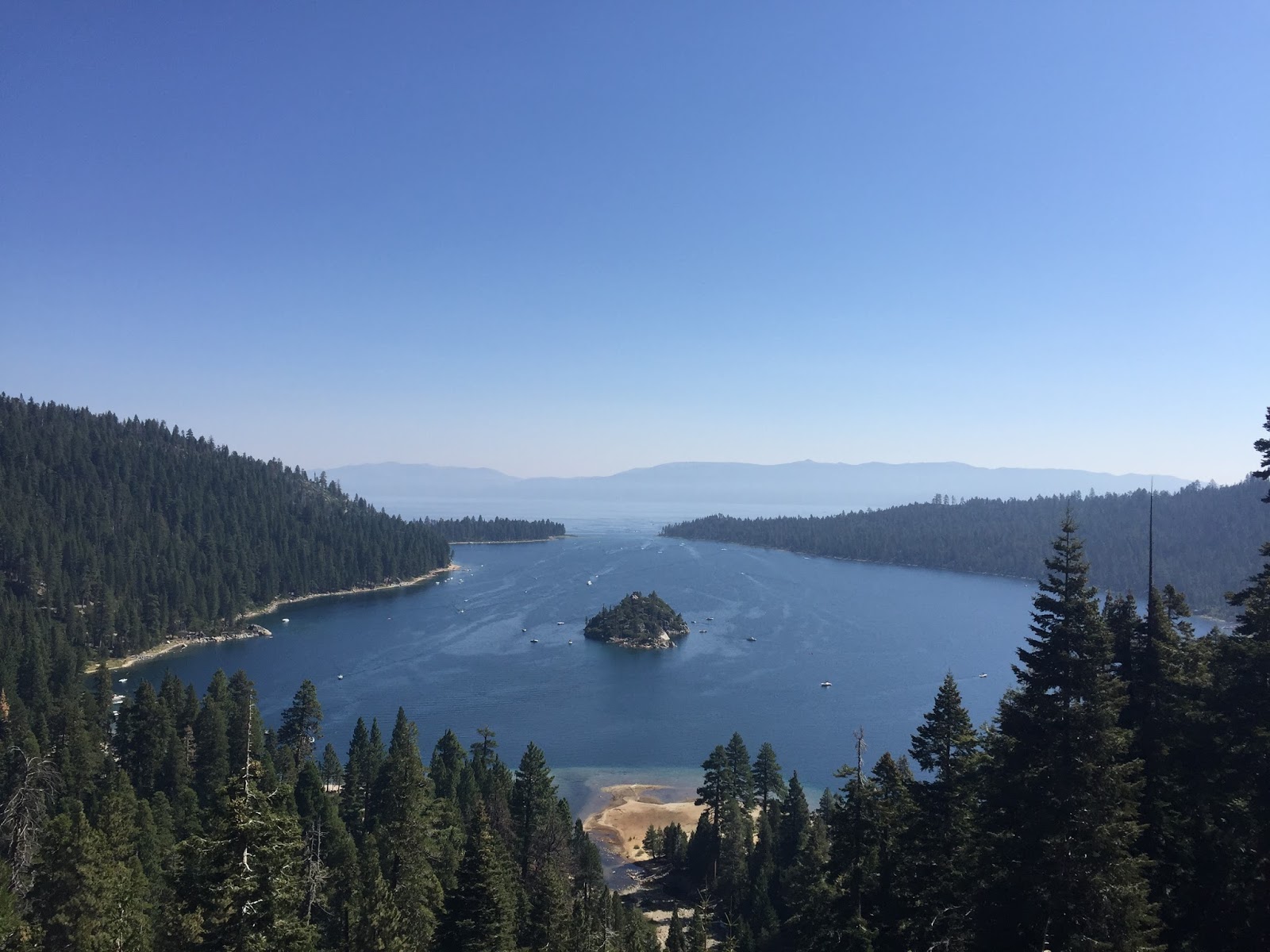
And it is gorgeous, as you can see, so there's nothing wrong with that. But I noticed this odd compulsion to stay constantly connected that somehow stands in the way of something deeper. I had brought with me Zadie Smith's book Changing My Mind, a collection of essays I'd been meaning to read for a while. Like since 2009 when it came out. Better late than never. The essays are wonderful, and a form I really respond to. Her essay on Middlemarch brought tears to my eyes. I even wrote her a fan letter. What I've noticed, though, is that this immediate connection, which also brings immediate emotions - happiness, outrage, anger, adrenaline - somehow stops the thought and more complicated feelings that comes when there is a deeper contemplation. Perhaps even this half-baked blog post is a symptom. I've been aware, though, that when I have an idea or something I want to explore, I'll move over to social media - either to share it before it is something deeper, or to just check something out and the idea melts away. I've noticed that joy comes out of contentment, and that takes time. Sharing is something I love to do, but share connotes a giving and a receiving. Posting makes more sense for what happens on social media, an activity that is much like stapling a notice for a missing animal on a light post.
Don't get me wrong - I enjoy social media, but it does not provide me with a sense of connection in the same way that actual connection does. That's probably why people feel more depressed the more time they spend on it (just Google 'social media and depression). A friend once said social media is like having a conversation at a cocktail party when someone randomly walks by and shouts "I love pickles!" and leaves. More aptly, perhaps, it's a giant room of people screaming their love for particular pickles. The absurdists would have a field day.
I do actually enjoy social media, but like any tool I have to figure out the best way to use it. Sometimes, when it's immediate reaction and response, it impedes a deeper response. I think that bay is instructive. Even looking at it now is calming. Sometimes to get the bigger picture takes a longer hike. I drove 7 1/2 hours to get up there. I hiked down a mile to Vikingsholm, the 38 room mansion built on the shore of the bay in the late twenties, and back up a mile. It was quite a steep walk, with panting dogs and complaining children being encouraged by their parents to keep walking. I was glad I went to see the house. I was sore the next day. Nothing about it was immediate, but I felt glad to have taken the time. There is no substitute for time and experience. I'm encouraging myself to go a little deeper.
Monday, August 22, 2016
Walking
I never know what it means to work on a poem, and usually it's just a jumble of words that come to me, and I feel better when I write them down. I suppose what you do is shave them, but in the meantime, this works as a repository.
Kicked off zig zag something like
that curlicue spiral while everyone walks
straight.
You leave the pattern like on grass.
You can't walk.
Set off in the wrong direction
again
You want to.
The thing is.
Blame.
Not much to do about it now
These are your feet and you walk
the way you walk.
Sideways, half-moon, circles, curled.
Kicked off zig zag something like
that curlicue spiral while everyone walks
straight.
You leave the pattern like on grass.
You can't walk.
Set off in the wrong direction
again
You want to.
The thing is.
Blame.
Not much to do about it now
These are your feet and you walk
the way you walk.
Sideways, half-moon, circles, curled.
Monday, July 25, 2016
Cleaning Up
Another friend died today. He was just past 50, and died after an illness. We weren't super close, but I did stay with him for a week in New York when he was doing a show there a few years ago. He was a light, fun fellow. He brought a lot of joy to people and smiled and laughed a lot. I always loved seeing him and we always gave each other a big hug. The last time he said we should get together for coffee.
For years I kept track of the people I knew who died - friends, colleagues, teachers, relatives. For a time I knew many people under 40 who died in freakish ways, from serial killer to suicide to cancer to meningitis to flesh eating virus. One day you'd get a call that someone had succumbed to a surprise illness and had left behind a partner, a child. Or there was an accident. So many surprising, unexpected ways. Grief is strange, unpredictable, which is all I've learned of it. I wrote a poem about it once -
The loss
Is a ring, an undertone
A tuning fork struck
Again again unexpectedly again
To begin -
The other day some circuitous thoughts led me to Joan Didion. Come to think of it, it's her quote, "a writer is always selling someone out," which is usually how she comes to mind, thinking of some idea and how it might offend someone. Anyhow, I thought of her loss of her husband and child in quick succession, and how insurmountable it must be to bear that loss. Then the thought came to me that there's some virtue in being the one left to turn out the lights. There must be. We'll all go. It's the unavoidable end we push from our minds so we can live our lives. It's probably just as hard to leave the the party when it's going, but there is some comfort to be taken in being the one to stay and clean up, to bear the grief, to continue the memory. That's how I look at it anyway, or have to. Someone came to the party and left. I hope he had a good time, and I'll certainly miss him.
For years I kept track of the people I knew who died - friends, colleagues, teachers, relatives. For a time I knew many people under 40 who died in freakish ways, from serial killer to suicide to cancer to meningitis to flesh eating virus. One day you'd get a call that someone had succumbed to a surprise illness and had left behind a partner, a child. Or there was an accident. So many surprising, unexpected ways. Grief is strange, unpredictable, which is all I've learned of it. I wrote a poem about it once -
The loss
Is a ring, an undertone
A tuning fork struck
Again again unexpectedly again
To begin -
The other day some circuitous thoughts led me to Joan Didion. Come to think of it, it's her quote, "a writer is always selling someone out," which is usually how she comes to mind, thinking of some idea and how it might offend someone. Anyhow, I thought of her loss of her husband and child in quick succession, and how insurmountable it must be to bear that loss. Then the thought came to me that there's some virtue in being the one left to turn out the lights. There must be. We'll all go. It's the unavoidable end we push from our minds so we can live our lives. It's probably just as hard to leave the the party when it's going, but there is some comfort to be taken in being the one to stay and clean up, to bear the grief, to continue the memory. That's how I look at it anyway, or have to. Someone came to the party and left. I hope he had a good time, and I'll certainly miss him.
Wednesday, July 13, 2016
On Surety
I just read Kathryn Schulz' article about Thoreau in the New Yorker, which points out what a difficult, narcissistic, hypocritical misanthrope he was, and how pernicious his ideas actually are, as they're not based in fact or experience, but opinion. It's quite an article, and fascinating to think of what is so interesting to him for the American imagination. One thing he was, though, was sure of himself.
I also recently finished a book by Dan Harris, 10% Happier: How I Tamed the Voice in My Head, Reduced Stress Without Losing My Edge, and Found Self-Help That Actually Works--A True Story It's quite a title.
I'm posting this because it was a draft of a post I started and didn't finish, and now the title is ironic. Sometimes it's worth it for a little laugh.
I also recently finished a book by Dan Harris, 10% Happier: How I Tamed the Voice in My Head, Reduced Stress Without Losing My Edge, and Found Self-Help That Actually Works--A True Story It's quite a title.
I'm posting this because it was a draft of a post I started and didn't finish, and now the title is ironic. Sometimes it's worth it for a little laugh.
How does this all work?
I haven't written on this blog in some time, but inspired as every by Elizabeth Aquino's blog, and how she writes daily, I thought I'd truck on over and put some words down, as my writing has been spotty of late.
Anyhow, when I logged in, I saw that my page, this one here, had 112 views on July 7th. This page normally has about 2 views a day, so I'm wondering what happened that day on the web that made 112 people visit my page. Not like they left comments, or even so much as wiped their feet on the rug, but it would be nice to know. You can't though. I can barely remember July 7th, and it was 6 days ago. How does this all work?
I'm noticing how fast things are moving. Blogging, which once felt like the most immediate form of communication, now feels as antiquated as letter writing. What with Twitter, Snap Chat, and Pokemon Go, we can immediately record and watch ourselves recording. We find ourselves so fascinating. Blogging is basically now journalism. Research? Who cares. I thought today that it's gone from "don't trust everything you read" to "don't trust anything you read." Yet, as you can read here, we have an endless need to write it, and an endless need to consume it. I love the phrase "crowded media landscape," which would imply land or something behind the crowd. At this point, there is the crowd, no sky above, no mountains behind, no sea below. Just crowded media.
So I guess I'm holding up my little virtual sign, too. Anybody else routinely overloaded?
This is becoming surprisingly bitter in a way I didn't expect. That's okay, though, I probably won't remember it tomorrow.
Sunday, November 22, 2015
Spontaneous Sunday Poetry
I listened to a story about a city in Brazil -
water dry in months for destruction of the rainforest.
A butterfly floated past looking for the memory of a field,
A bee hovered at my car window, which will never be a flower.
water dry in months for destruction of the rainforest.
A butterfly floated past looking for the memory of a field,
A bee hovered at my car window, which will never be a flower.
Friday, November 20, 2015
Audience
I have a cold, but just wanted to jot this down before I forget it. It's an old question.
Back in the ye olde times before social media, smartphones, and more than a handful of television stations (aka the 80s), there was a horrible disease that was afflicting many gay men in major metropolitan areas. Journalists at the time would say things like, "It hasn't infected the general population", which was a way to create fear while simultaneously assuaging it, I suppose. Fear of the other. As a young gay man, a high schooler in fact, it didn't occur to me to question who was speaking, only to internalize that I was not being spoken to and was not part of the general population. I don't think I could have articulated it at that moment, but certainly I was taking it in. Someone was being spoken to, and that person was speaking to someone about me, who was not me. I was still a virgin, but I knew. I was not part of the general population.
I was in my car today, and my usual news program featured a story about the college protests currently happening. What struck me was the tone of the news, which I catch now and again, that by its very nature separates reporter, and by extension the listener, from subject. I hear it a lot. It's a bias. I always wonder though, who is the audience? What's being assumed? Who are they talking to? The subject is always separated and analyzed, but the assumption is somehow that the subject is not part of the "general population" in some way. But who is the audience?
Like I said, I have a cold, so not quite clear on an answer as of yet, but I'm interested in the question. Just who are they assuming they are talking to?
Back in the ye olde times before social media, smartphones, and more than a handful of television stations (aka the 80s), there was a horrible disease that was afflicting many gay men in major metropolitan areas. Journalists at the time would say things like, "It hasn't infected the general population", which was a way to create fear while simultaneously assuaging it, I suppose. Fear of the other. As a young gay man, a high schooler in fact, it didn't occur to me to question who was speaking, only to internalize that I was not being spoken to and was not part of the general population. I don't think I could have articulated it at that moment, but certainly I was taking it in. Someone was being spoken to, and that person was speaking to someone about me, who was not me. I was still a virgin, but I knew. I was not part of the general population.
I was in my car today, and my usual news program featured a story about the college protests currently happening. What struck me was the tone of the news, which I catch now and again, that by its very nature separates reporter, and by extension the listener, from subject. I hear it a lot. It's a bias. I always wonder though, who is the audience? What's being assumed? Who are they talking to? The subject is always separated and analyzed, but the assumption is somehow that the subject is not part of the "general population" in some way. But who is the audience?
Like I said, I have a cold, so not quite clear on an answer as of yet, but I'm interested in the question. Just who are they assuming they are talking to?
Subscribe to:
Posts (Atom)